Oligonucleotide synthesis and purification facility
Publié le

Teams at the Pasteur Institute’s Department of Bio-organic Chemistry of Nucleic Acids have developed an experimental platform for synthesising and purifying oligonucleotides.
Marcel Hollenstein, Institut Pasteur, head of laboratory of Bioorganic Chemistry of Nucleic Acids nous parle de ce plateau.
What are the objectives of this Institut Pasteur platform?
Our small oligonucleotide synthesis and purification facility aims at producing chemically modified sequences ranging from 2 to ~100 nucleotides. These modified oligonucleotides are key elements in our PEPR project since modulation of the pH will particularly affect the modified nucleotides.
Consequently, a modification of the pH will directly change the nature of the nucleotide that will be incorporated by polymerases via templating modifications. Such modified sequences will also be used in ligase-based approaches to construct yet longer (i.e. up to 1000 nt) modified sequences, the main aim of our project.
In addition, our facility can prepare oligonucleotides with alternative modification patterns of interest to any of the members of our consortium. This encompasses 5’/3’-terminal modifications such as biotin or thiol to immobilize sequences on surfaces such as electrodes or magnetic particles, abasic sites or universal bases to block polymerases or favor the introduction of any type of nucleotide, respectively, or other functional tags.
How does this technical platform work?
Following the design of sequences, directly in our lab or by our collaborators, we then synthesize the modified amidites if they are not commercially not available.
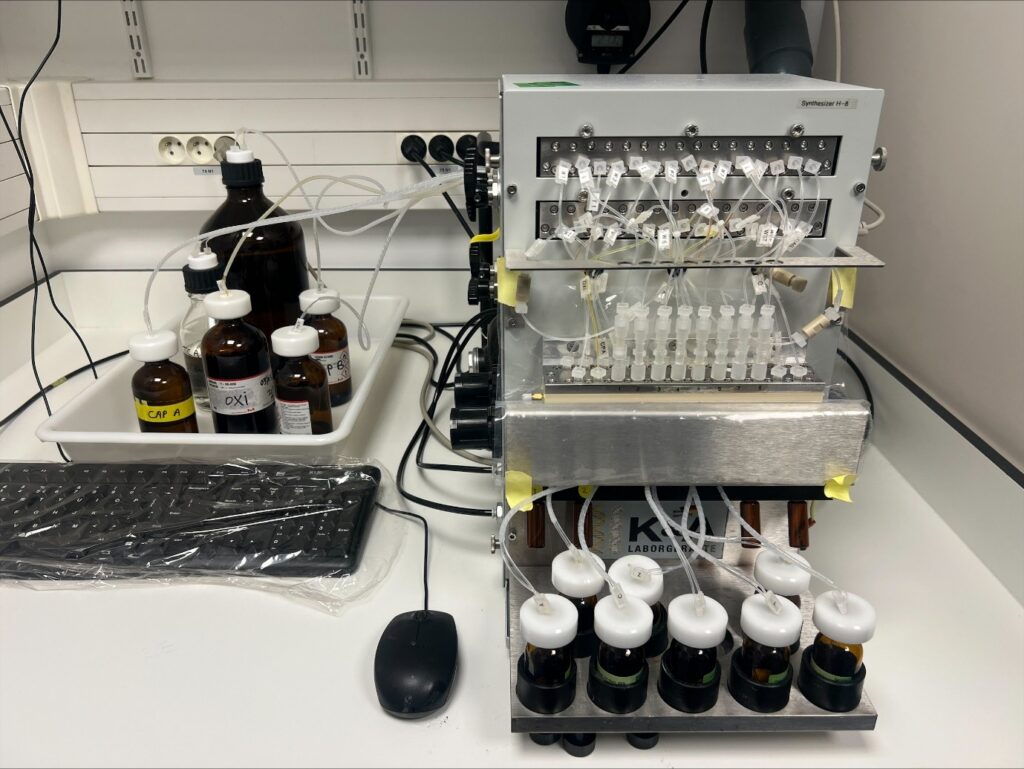
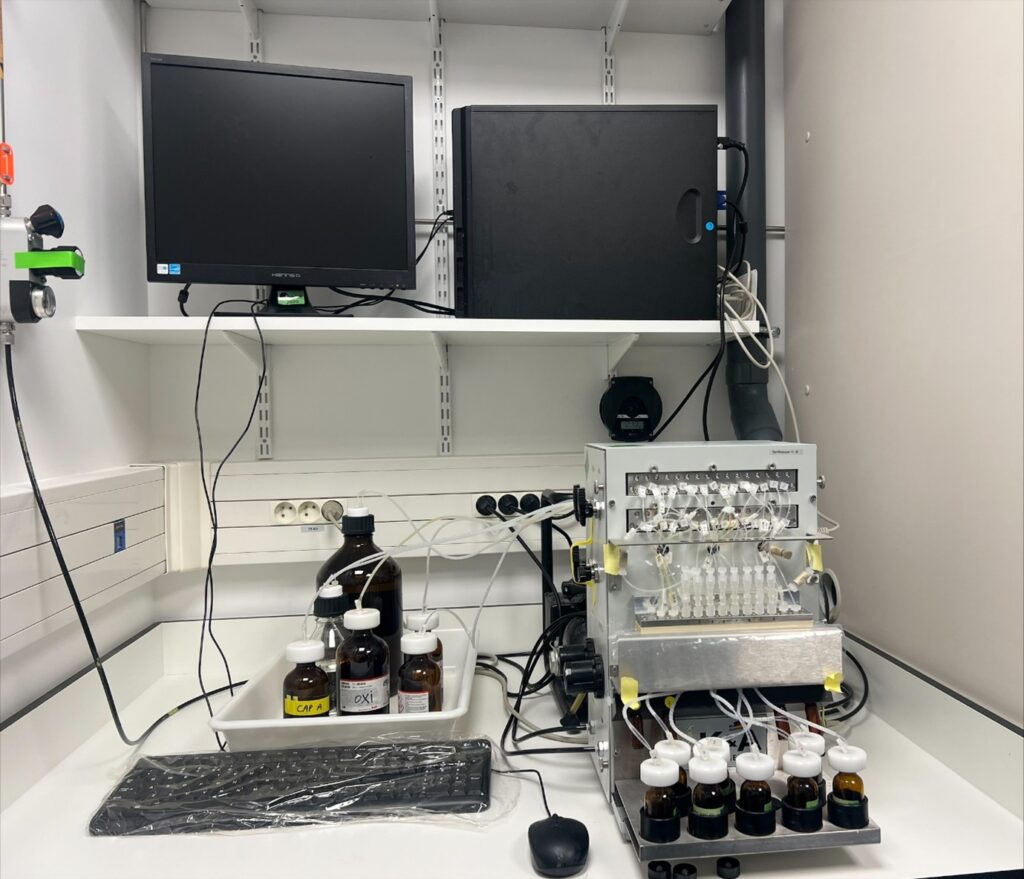
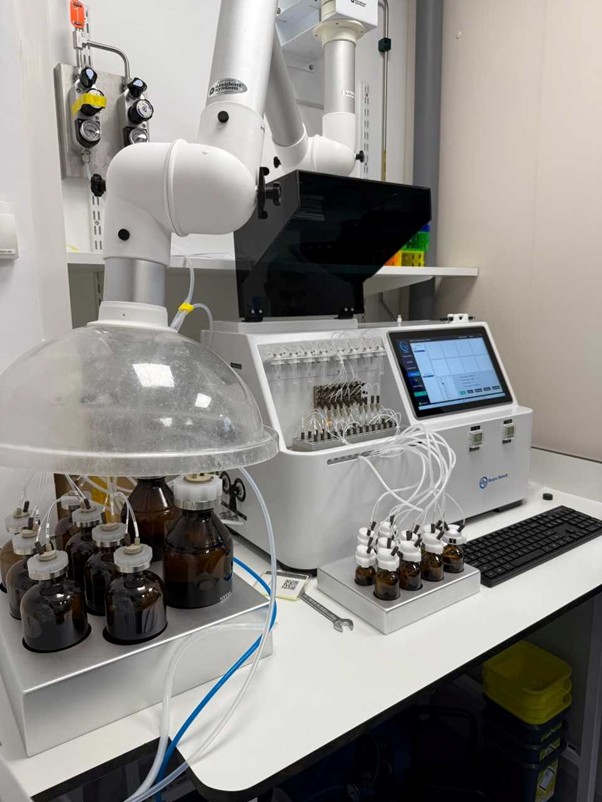
This is a multi-step synthesis project including thorough purification and analysis of the chemical integrity of all intermediates and final products. With all amidites in hand, we then initiate the synthesis of the sequences using our K&A DNA synthesizer.
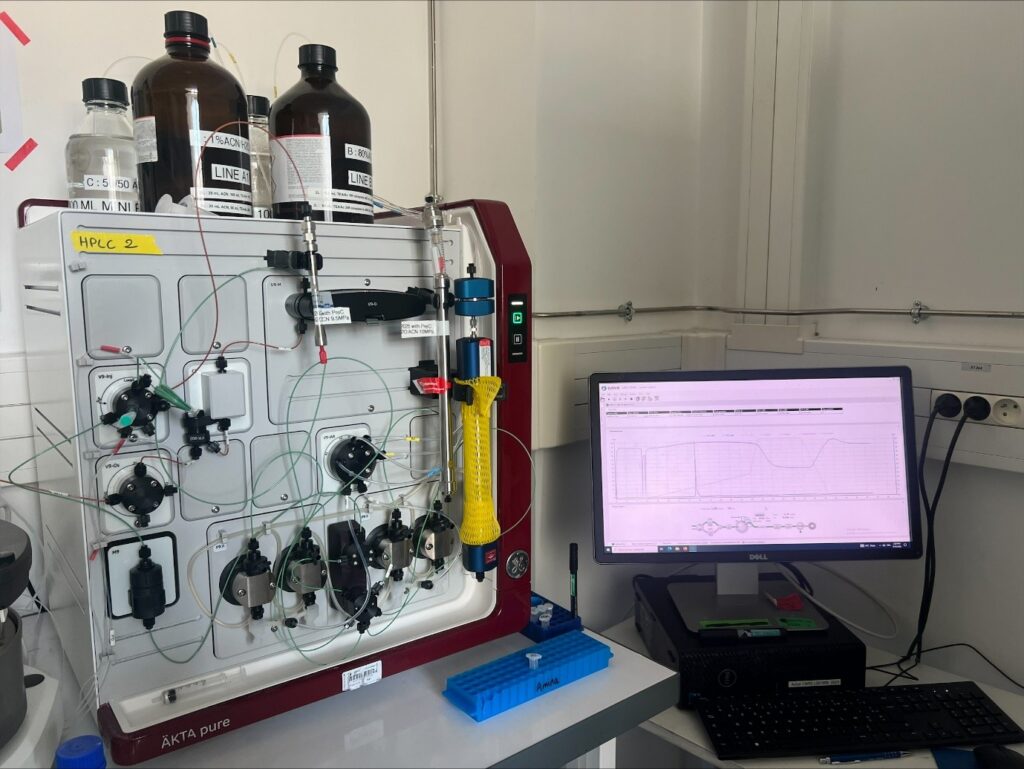
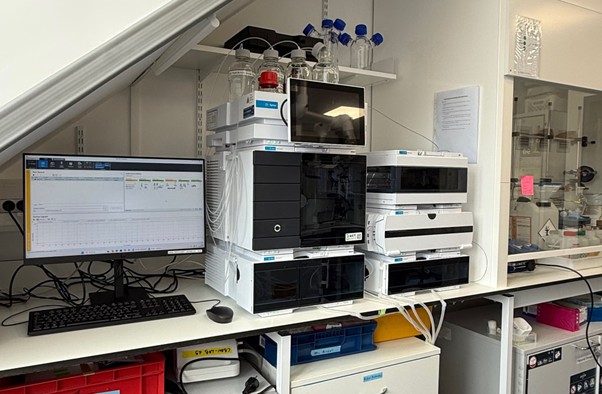
After completion of the synthesis, the solid-support is treated with ammonia to remove the protecting groups and cleave the sequence off the resin. After removal of ammonia, the sequences are purified by RP-HPLC and/or anion exchange HPLC.
Finally, modified oligonucleotides are then subjected to an LC-MS and/or MALDI-ToF analysis prior to quantification. Sequences can then be sent to collaborators or used in house for downstream applications.
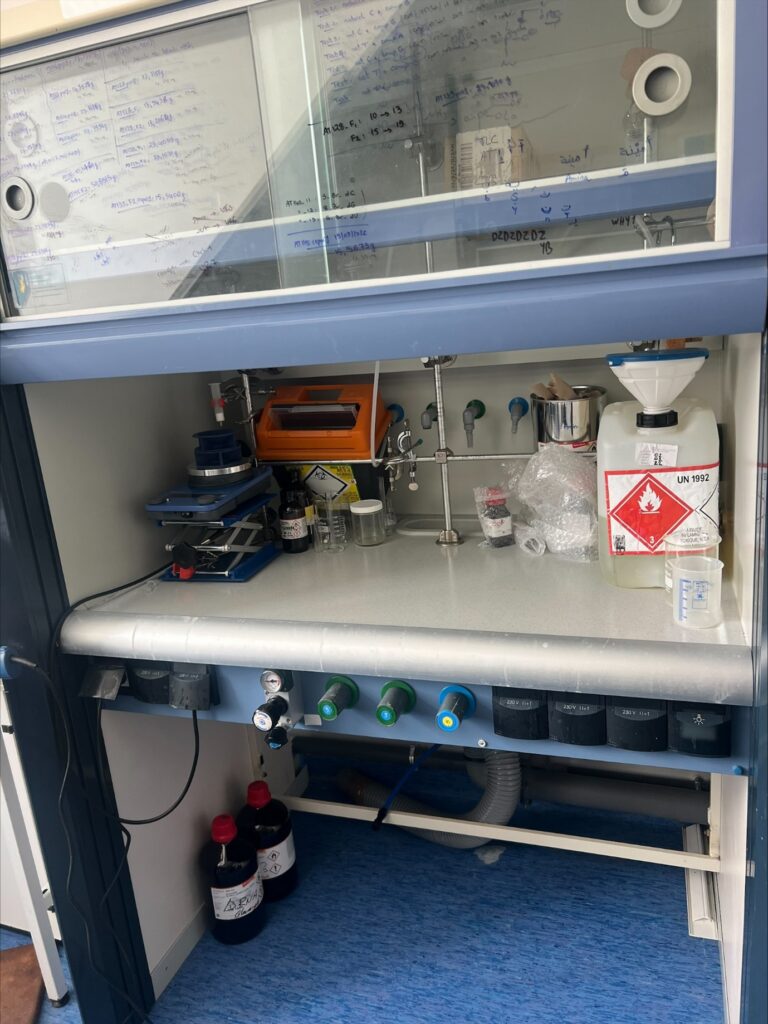
Some pictures of the technical platform
What was the timeline for the launch of this technical facility?
Historical perspective :
Initially, sequences were synthesized by a PhD student and a CNRS permanent researcher on a case-to-case situation. After hiring a research engineer in late 2024 in the framework of this PEPR project, the facility strongly improved its capacity. We are currently on the verge of acquiring a new DNA synthesizer to yet further increase our production capacity.
Duration for the synthesis of modified oligonucleotides
The exact duration of the synthesis of a modified sequence depends on a number of parameters including length of the sequence, number of modified nucleotides to be incorporated, and whether the modifications are commercially available or whether they need to be produced. In the worst case scenario, i.e. a long sequence (~92 nt) with multiple modifications which are not commercially available, at least two months should be considered from start to end. In the best case scenario, i.e. standard modifications on a short sequence (~15 nt which we prepare for another part of our PEPR project), the duration does not exceed 10 days.
What is the benefit of this platform for the PEPR?
As mentioned previously, the modified oligonucleotides are at the heart of the PEPR project because they represent the templates that will dictate the nature of the oligonucleotides produced by polymerases as a function of pH changes.
In addition to these longer templates, we have initiated a vast analysis of the effect of base-modifications on duplex stability as a function of pH and mispairing.
We believe that the results stemming from this vast analysis will facilitate the identification of alternative base-modifications to be used in longer templates. Potentially, the vast amount of data could be implemented in algorithms to predict the effect of pH on modifications on mispairing capacity.
What are the outlook for this technical facility?
Since the hiring of the research engineer, the facility has stepped into a new degree of maturity. We have also been able to produce some modified oligonucleotides that were only loosely connected to the PEPR project (e.g. for the chemoenzymatic labelling of oligonucleotides with GalNAc ligands in collaboration with the team of Yannick Rondelez) and external collaborators.
We will continue producing oligonucleotides for the PEPR project and are considering to implement backbone and sugar modifications to evaluate their dependence on alterations of pH. The future of the facility obviously strongly depends on the presence of our highly qualified research engineer.
A technical facility dedicated to
DNA synthesis
Published on
Researchers at the Gulliver laboratory (CNRS / ESPCI) have developed an experimental platform for the directed evolution of enzymes.
Kévin Ricard, a research engineer at the Gulliver laboratory, tells us about this state-of-the-art facility.
What are the objectives of this Gulliver Laboratory platform?
Firstly, it is necessary to define “directed evolution”: this involves modifying a protein or enzyme using multidisciplinary techniques to improve one of its characteristics, such as its stability or function.
The platform’s objective is to offer a protein engineering support service for the directed evolution of enzymes, from the design of libraries through to the isolation and sequencing of mutants (the modified enzymes), and the performance of activity assays.
How does this technical platform work?
The initial discussion phase is crucial. The aim is to gain a clear understanding of your needs and expectations. We then propose the most suitable solution. This is a key strength of this platform: our processes are highly adaptable to the specific projects we discuss.
Here are the services we offer:
- Creation of enzyme libraries by introducing targeted and controlled mutations using a unique protocol developed on the platform.
- Identification and isolation of mutants from a library, on plates, using PCR and high-throughput sequencing. Up to 10,000 unique variants.
- High-throughput enzyme activity testing. This can be carried out according to the enzyme’s function. Up to 1,000 variants simultaneously.
- High-throughput sequencing service using Nanopore technology (Flongle / Minion / Promethion)
Equipment currently in use:
The Gulliver laboratory platform was designed for plate-based work. Gene libraries are created by modifying the enzyme gene in a single tube, generating up to 10 billion variants. These are then introduced into bacteria before being identified on plates using PCR and high-throughput sequencing.
In conjunction with these machines, we have added dispensing or plate transfer robots such as the Opentron flex, the I-Dot and the Viaflo 96. This allows us to semi-automate the processes. Finally, we have a large high-throughput Nanopore sequencing capacity with 3 MinIONs and 2 PromethIONs.
Some pictures of the technical platform


What was the timeline for the launch of this technical facility?
The platform was conceived in 2022 and launched in 2023. Since 2024, we have been open to collaborations and have already carried out projects with more than a dozen laboratories and companies. We are continuing to expand our capacity and diversify our services, particularly through ultra-high-throughput approaches.
What is the benefit of this platform for the PEPR?
The PEPR focuses on how to create new molecules and information technologies to accelerate the synthesis of various types of molecular media (particularly DNA), whilst optimising their encoding and decoding.
In this context, we are focusing on the enzymes that synthesise DNA, which is a universal carrier of life.
Imagine DNA as a language that would allow us to store digital information in a physical, stable and durable way. By controlling the enzyme that synthesises DNA, we could store any digital data!
The platform currently enables us to carry out directed evolution on certain DNA polymerases to make them faster and more adaptable in DNA synthesis, which is one of the hurdles the project must overcome.
What are the outlook for this technical facility?
For the time being, we are continuing our work on the PEPR whilst developing our open platform for research teams. The standardisation of processes is complete, and we are working to increase our capacity by implementing semi-automated processes.
We are open to collaborations and hope that by 2026 the fruits of our labour will be recognised with the first articles published by our collaborators and our platform.
We also wish to develop our offering of training in directed evolution techniques for the community.
In the longer term, we aim to establish the platform as a permanent fixture in the French research landscape to assist laboratories and companies that need to rapidly engineer enzymes/proteins but lack the in-house expertise
Plus de projets