DNA cryptography: new perspectives!
Publié le 21 avril 2026
During the official visit of Emmanuel Macron, accompanied by Antoine Petit, CEO of CNRS, an unprecedented technological demonstration highlighted a major breakthrough: the use of DNA as a cryptographic medium. This project, initiated within the PEPR MoleculArXiv framework, demonstrates the potential of this technology to secure and store data in an ultra-dense manner.
An unprecedented technical demonstration
On April 1st, 2026, during the official visit of Emmanuel Macron and Antoine Petit to Japan, a DNA cryptography experiment was presented. This demonstration validated, under real conditions, a functional prototype that leverages the unique properties of DNA to encode and store data in an ultra-compact and secure way.
To achieve this, researchers used:
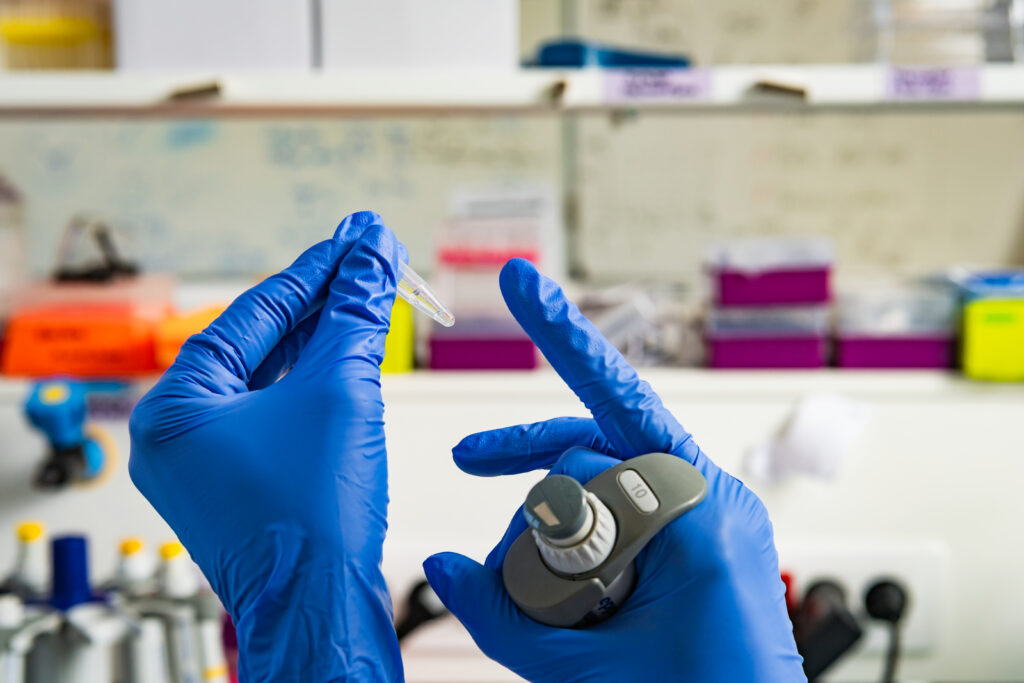
- Microfluidic tools (fluid control chips) and electronic tools (real-time detection systems) to manipulate and read data.
- Synthetic DNA sequences as a storage medium.
An innovative approach to secure DNA storage
Unlike traditional methods, this solution leverages:
- The high density of DNA: multiple exabytes can be stored per gram;
- Its stability: data can be preserved for millennia without degradation;
- An encryption inspired by the Vernam system (One Time Pad): each piece of information is protected by a unique random key, making decryption impossible without that key.
The teams and partners involved
This project is based on a Franco-Japanese collaboration involving:
- Université de Limoges (expertise in cryptography);
- IMT Atlantique (data modeling and security);
- ESPCI Paris – PSL (synthetic biology and polymer chemistry);
- The LIMMS (Franco-Japanese International Laboratory of Micro-Nano-Technologies, CNRS/University of Tokyo) for microfluidic and sequencing aspects.
This project, initiated under PEPR MoleculArXiv, is now being pursued and deepened by the ANR DNA Sec.
DNA: a storage solution for the future
DNA is also a revolutionary storage medium: durable, ultra-dense, and secure. This is precisely the potential we are exploring within the framework of our PEPR. An innovation that opens up immense prospects for data storage in the face of energy-intensive data centers.
L’ADN, une révolution cryptographique de Julien Moro © CNRS – 2026
Plus d'actualités News